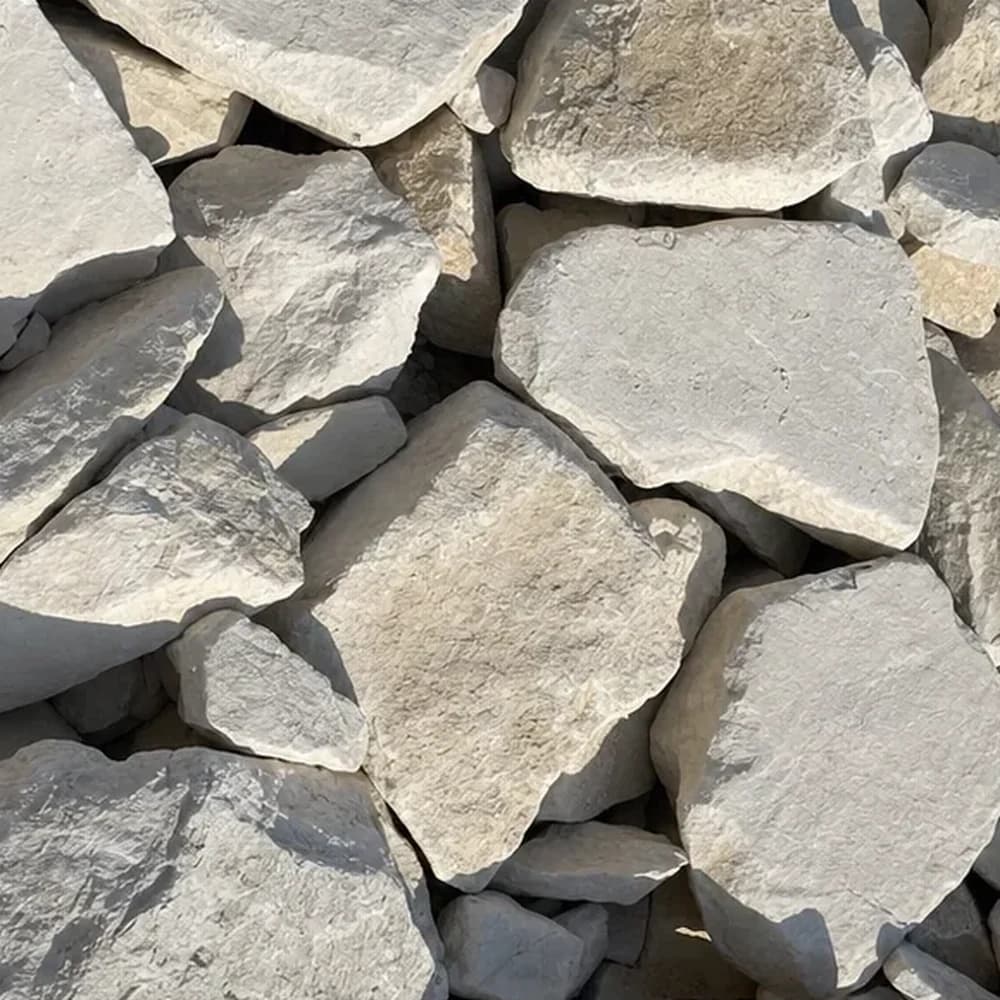
Rip Rap Calculator: Tons for the Bank in Front of You
Enter your project dimensions
Stand at the top of the bank after ice-out and the damage is easy to read. A vertical cut where there used to be a slope, grass hanging over the edge with nothing under it, and a scatter of stone at the bottom that has moved since last fall. Stretches of Great Lakes shoreline in this state carry a high risk erosion area designation, and the same undercutting happens on pond banks and stream banks inland after every thaw. This rip rap calculator turns what you can see into a tonnage, and the first measurement is the one people get wrong.
Do you measure the lawn or the face of the bank?
The face. Water works on the slope, not on the flat ground above it, so the area that needs armoring is the sloped surface from the toe at the bottom to the top of the bank, measured along the slope rather than across the yard. A bank that is four feet high and cut at a two to one slope runs eight feet across the ground and nearly nine feet down the face. The face is what the stone covers.
Take a tape down the slope for that dimension, then measure along the shore or channel for the length. A hypothetical 50 feet of pond bank with a 6.5-foot face is 325 square feet, and 325 is what goes into the tool.
How thick a layer does 4 to 12 inch stone need?
One and a half to two times the largest stone in the load, with 12 inches as the practical floor for erosion work. Residential RipRap in the 4 to 12 inch range usually lands at 12 to 18 inches, and faster water or larger stone pushes that to 24.
The depth field accepts 0.25 to 24 inches, so the top of that range is exactly the tool's ceiling. Anything thicker has to be run as two passes and added, and at that point you are past what a page can advise anyway.
Slope angle sets the rest. Grade the bank to two to one or flatter before stone goes on. Steeper than that is an engineering problem, and no amount of extra rock solves it.
Why does 325 square feet come back as 28 tons?
Because armor stone is the heaviest material on the site: about 3,100 lb per cubic yard, or 1.55 tons. Run the pond bank at an 18-inch layer:
- 325 x 18 / 12 = 487.5 cubic feet
- 487.5 / 27 = 18.06 cubic yards
- 18.06 x 1.55 = 28.0 tons
Coverage explains why the pile looks small. At 12 inches thick, one ton covers about 17 square feet; at 18 inches, about 12; at 24 inches, about 9. A load that would surface a long driveway disappears into fifty feet of bank.
The tool takes a rectangle, a circle by diameter or up to five areas at once, in feet, and returns cubic yards, tons and cubic feet together, with the option to email the estimate. The 5 percent allowance is worth ticking here, though not for compaction: armor stone does not compact, and the extra covers the stone that settles into the toe trench and the pieces that end up in the water during placement.
What goes under the stone, and how much of it?
Stone laid on bare soil looks right for a season, then the bank erodes out from beneath it and the whole layer slides. Either non-woven geotextile, which a landscape supplier carries and this site does not, or 3 to 4 inches of #4 crushed stone goes down first as a filter.
That bedding is part of the order, sized on the stone calculator. The same 325 square feet at 4 inches works out at 108.3 cubic feet, 4.01 cubic yards, and about 5.8 tons at the 2,900 lb per yard figure for #4 stone. Two other placement points that change quantities: dig the toe in below the waterline or below expected scour depth, because failure starts at the bottom, and at a culvert outlet carry the apron four to six pipe diameters downstream.
Before any stone goes below the ordinary high water mark of a lake, stream, pond or Great Lakes shoreline, check what approval your state and local authorities require. Placing rock in and along water is commonly permitted work, and this page is not a substitute for asking.
RipRap, #4 stone or large river rock at the waterline?
- RipRap is angular armor stone. Four to eight inch material suits pond banks, slow streams and downspout outfalls; eight to twelve inch handles lakefront exposed to boat wake, ice shove and faster channels.
- #4 crushed stone is the bedding layer beneath, not the armor. It also does duty on construction entrances and in trench bottoms.
- Large river rock is rounded and decorative, which is exactly why it travels in moving water. Keep it in dry creek beds and borders above the waterline.
- Drain rock answers water moving through the ground behind a wall or under a lawn, which is a different problem from water working at the face of a bank.
When the choice is between two sizes, take the larger stone and the thicker layer. If the bank is not one of the ordinary cases, talk the bank through first. Highway and spillway work carries its own engineered sizing, so use the drawing rather than this page. Walk the bank after the first big storm and again a few times a year, reset anything that has shifted, and check whether fabric is showing through.
Once the tonnage is set, put the quantity and a delivery date on the product page and finish at checkout, where delivery is arranged by ZIP code. Think hard about what the truck needs on arrival in the last twenty feet of the approach: spring ground near a pond or a shoreline will hold a loaded truck, and stone that gets dropped in the wrong place has to be moved twice.
Common questions
Where should the pile go if I cannot get the truck to the bank?
Pick the firmest ground with a straight run to the work and drop it there, even if that means a longer push with the machine. Stone dumped on soft spring ground near the water is the one delivery decision that gets expensive, because moving armor stone a second time costs more effort than placing it did. Check the route on foot before you book the date, and leave the driver a level spot with clear overhead space.
Why does the estimate show tons and cubic yards when the stone is sold by the ton?
The cubic yard figure is the volume of bank you are filling, and it is what you check your measurements against. The ton figure is what gets ordered and what arrives. Keeping both in view is how you catch an error: if 18 yards comes back as 28 tons, the ratio is right for armor stone, whereas the same volume showing 24 tons would mean a lighter material is selected.
Is the layer thickness measured loose or after it settles?
As placed. Armor stone is set, not compacted, so the thickness you enter is the thickness of the finished layer once the stones are arranged to interlock rather than left where the bucket dropped them. That is different from base stone, where the depth you enter is the depth after a plate compactor has been over it.
The bank curves around a round pond. Can I use the circle mode?
Not for the bank itself. Measure the shoreline as a length, the way you would walk it, and multiply by the slope face. Circle mode is useful for the flat, roughly round areas that come with this sort of work, such as a splash pad under a downspout or the apron at the mouth of a culvert, where you enter the diameter and a depth.
How do I check the tonnage by hand before ordering?
Multiply the slope-face area by the layer thickness in feet, divide by 27, then multiply by 1.55. For a 10 by 10 trial patch at 12 inches, that is 100 cubic feet, 3.7 cubic yards and about 5.7 tons. Doing one small patch by hand first is a good habit here, because armor stone is the material where a measuring error costs the most.
Related calculators
Banks don't armor themselves.
RipRap by the ton with free delivery, plus the #4 bedding stone to go under it.