River Rock Calculator: Tons for a Bed You Lay Once
Enter your project dimensions
A Michigan year gives you two short windows for laying stone in a bed. One opens when the thaw has finished and the ground has firmed up, while the channels snowmelt cut across the yard are still plain to see. The other comes after leaf drop, when the perennials are cut back and there is nothing left to work around. The measuring happens in the weeks before either one, and that is what this river rock calculator is for.
Measuring a dry creek bed that bends around the maples
A creek bed is a ribbon, not a rectangle, so measure it the way water would run it. Walk the center line with a tape and note the length. Then take the width at three or four points along it and average those, because a bed that pinches to three feet between two maples and opens to six at the outfall is not a six-foot bed.
Take a hypothetical run of 34 feet with an average width of 4.5 feet, laid four inches deep:
- 34 x 4.5 = 153 square feet
- 153 x 4 / 12 = 51 cubic feet
- 51 / 27 = 1.89 cubic yards
- 1.89 x 1.35 = 2.55 tons
- with the 5 percent allowance ticked: 1.98 cubic yards, 2.68 tons
Round that to three tons and put the balance at the outfall, where spring runoff moves stone first. Set the largest anchor pieces about a third of their height into the ground so they look placed by water rather than dropped on it.
Typing a bed in: feet across, inches deep, stone chosen last
Three shapes are offered. A rectangle covers most borders and beds. A circle takes one diameter, which suits a ring around a fire pit or a specimen tree. Multiple areas totals up to five separate pieces in one calculation.
Lengths, widths and diameters go in feet. Depth goes in inches and the field accepts anything from 0.25 to 24. The material select comes after the dimensions, and below it sits an optional checkbox that adds 5 percent for compaction and spillage. It starts ticked, and nothing is added if you untick it. Press calculate and the answer comes back as cubic yards, tons and cubic feet together, with an option to have the estimate emailed rather than copied onto the back of an envelope.
The multiple-areas option earns its place on small work. Four downspout splash pads at 3 by 3 feet each, three inches deep, come to 36 square feet, 9 cubic feet, 0.33 cubic yards and about 0.45 tons between them. That is not an order on its own. Added to the creek bed above, it is one delivery.
2,700 pounds to the yard, and why a ton looks small in the driveway
Square feet times depth in inches, divided by 12, gives cubic feet. Divide by 27 for cubic yards. Multiply cubic yards by the published weight for tons, and for river rock that figure is about 2,700 lb a yard, or 1.35 tons. Rounded stone sits at the lighter end of the list: pea stone and #57 are figured nearer 2,800 lb for the same hole in the ground.
Turned round, a delivered ton is roughly three quarters of a cubic yard, which is why the pile on the drive looks smaller than the tonnage sounds. Spread two inches deep it reaches about 120 square feet, at three inches about 80, and large river rock at four to five inches about 53.
Depth follows stone size, so a 1-inch bed is not a 3-inch bed
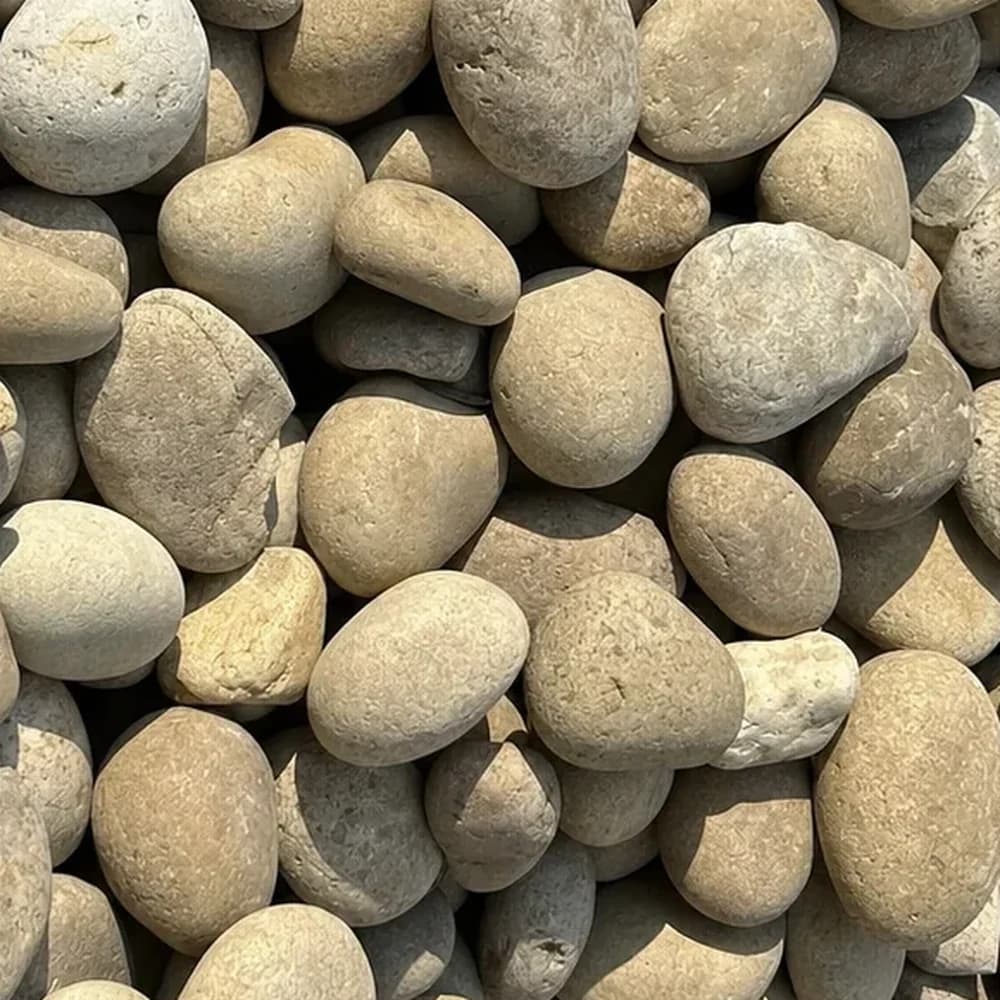
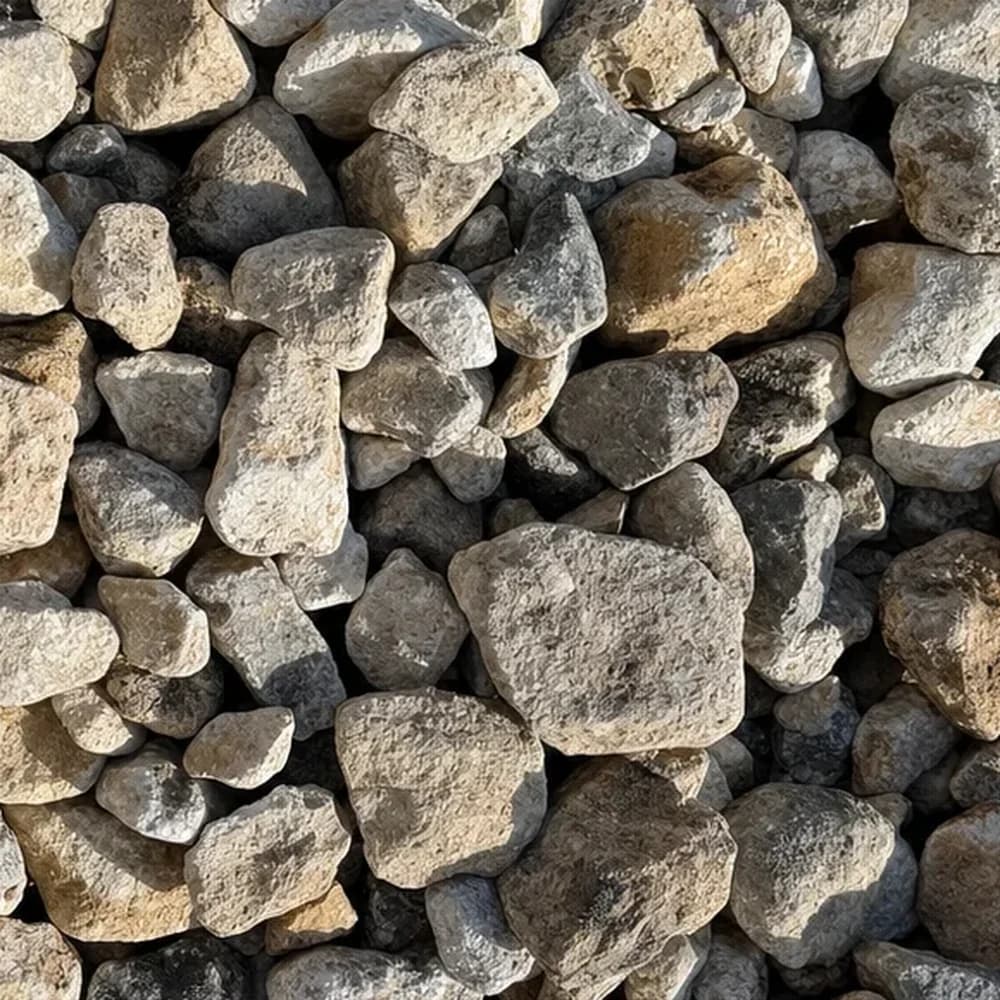
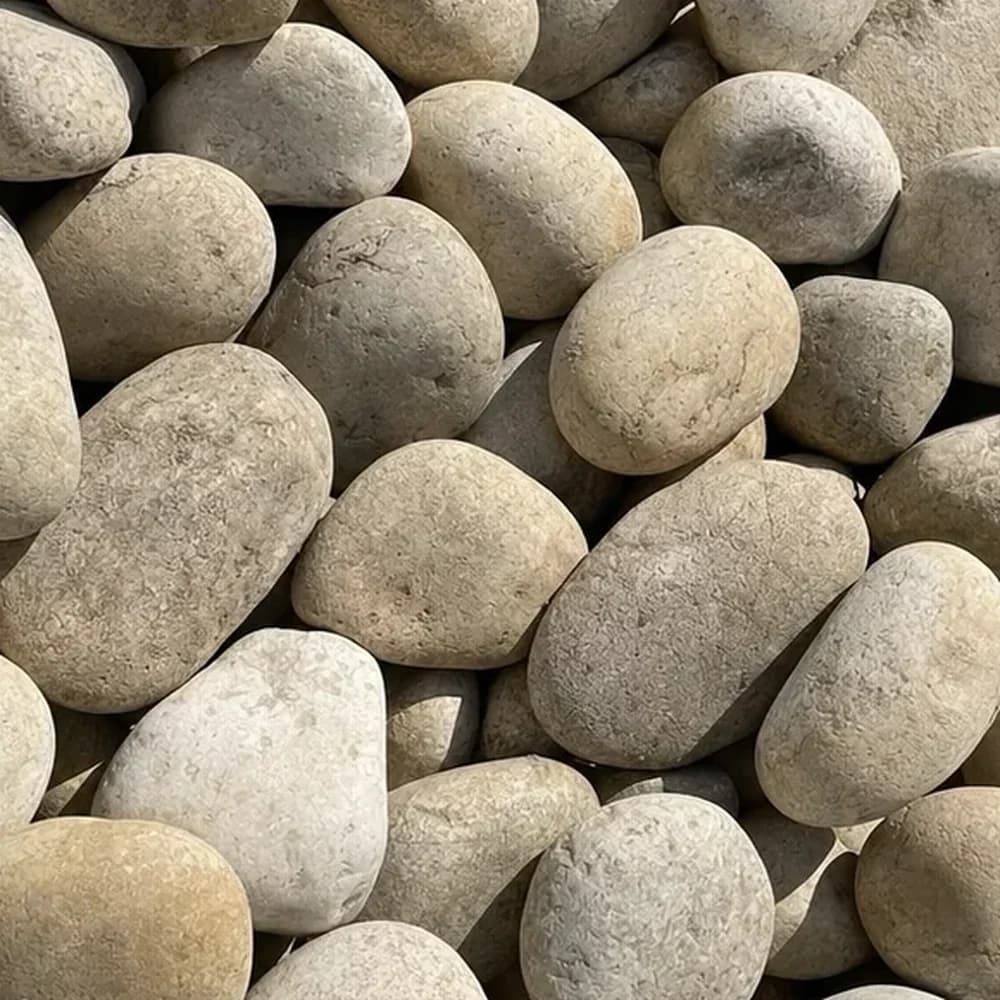
Plan the layer at roughly twice the diameter of the stone. Three-quarter to one inch stone wants two inches. One to three inch stone wants three to four. Large stone at two to four inches wants four to five. That is the whole reason two beds of identical footprint can differ by half again in tonnage, and it is worth settling before you touch the depth field.
If fabric or soil shows through after spreading, the layer is too thin rather than the order too small. Pin non-woven fabric down first and spread over it. Where the stone is doing real drainage work rather than decoration, the fabric wraps the stone instead of sitting under it, which is drain rock territory and a different job.
Two Michigan habits are worth building in. Keep decorative beds back from the plow line along a drive, because a wing plow will throw rounded stone into the lawn and the mower will find it in May. And rinse the bed once it is spread, since quarry dust leaves stone looking gray until it has had a hose on it.
Where the spare stone goes once the bed is spread
Five percent covers spillage and the dip you did not measure. It does not cover a depth you guessed wrong, and it is not a substitute for rounding up to the next whole ton. Stone is sold by the ton here, and the place to spend the balance is the front edge of the border, where the layer thins first and where anyone walking past is looking.
Frost heave lifts a stone bed unevenly over a winter. Expect to rake the surface back level in spring rather than to add material, at least for the first few years. That is the trade for a surface that does not need renewing the way a bed of shredded mulch does, and running the same footprint through the mulch tool is a quick way to see how differently the two land on a delivery ticket.
When the tonnage looks right, open the product page, set a quantity and a date after the ground has thawed, and finish at checkout, where delivery is arranged by ZIP code. Leave the truck a firm spot to tip on, close enough to the bed that the wheelbarrow route does not cross new grass.
Common questions
Is ticking the 5 percent enough on a rock bed, or should I round the tons up too?
Do both. The 5 percent covers spillage and small measuring errors. Rounding to the next whole ton covers the part nobody measures, which is the edge of the bed, where the stone always finishes thinner than the middle.
The bed runs down the bank toward the water. Do I measure the slope or the flat ground plan?
Measure along the face of the slope, not the plan view, because that is the surface the stone has to cover. Run a tape down the bank from top to bottom and use that as the length. On anything steeper than about one in three, allow a little extra as well, since stone creeps downhill before it beds in.
The border turns the corner of the porch. Is that one area or two?
Two, entered under the multiple-areas option, with its own width on each leg. Measuring the outside of an L in one pass double counts the corner square. The tool adds up to five pieces and returns a single yardage.
There are boulders in the bed I am keeping. Do I take their footprint out of the area?
Only if they are large. A few field stones displace less than the rounding already built into the order. Anything over roughly three feet across is worth subtracting, since a cluster of those can account for most of a ton on a small bed.
The creek bed needs smaller stone under the big anchor pieces. How do I order two sizes?
As two runs of the tool over the same footprint. Put the one to two inch layer through at its own depth, then handle the anchor stone separately, since large pieces are placed rather than spread and are counted by what looks right at the outfall rather than by depth.
Related calculators
Rock beds are a one-time buy.
River rock, large river rock and drain rock by the ton, free delivery included.